
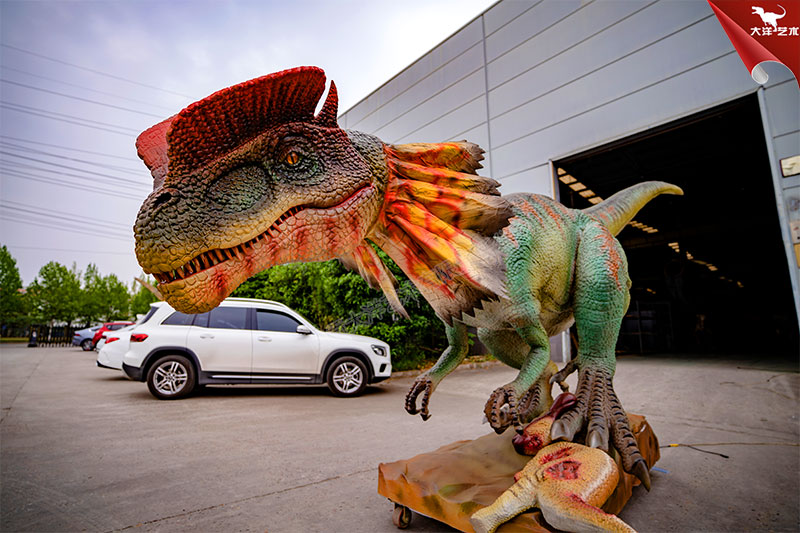
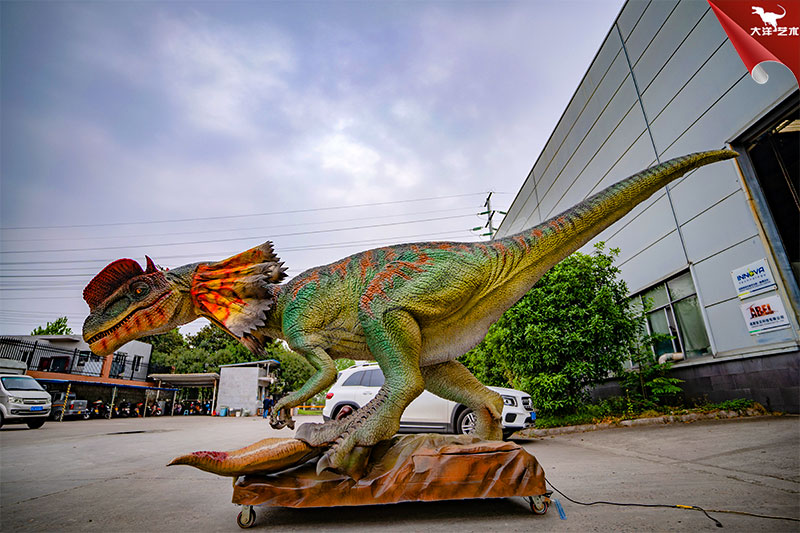
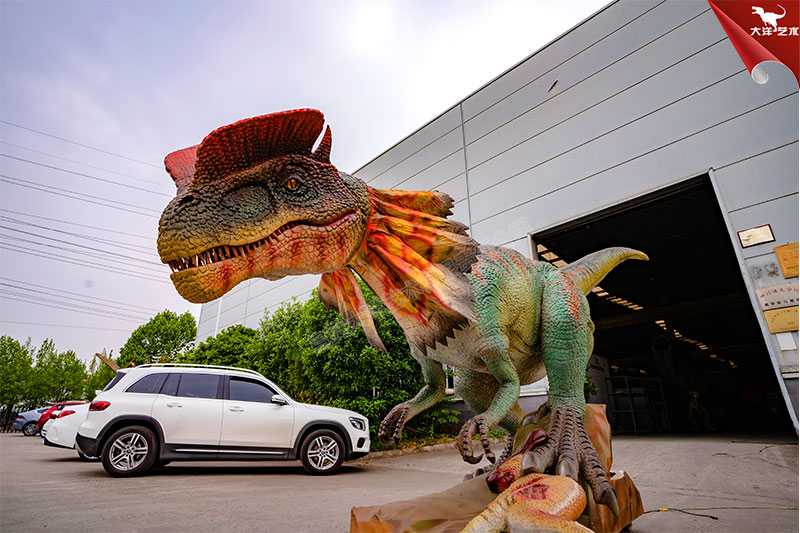
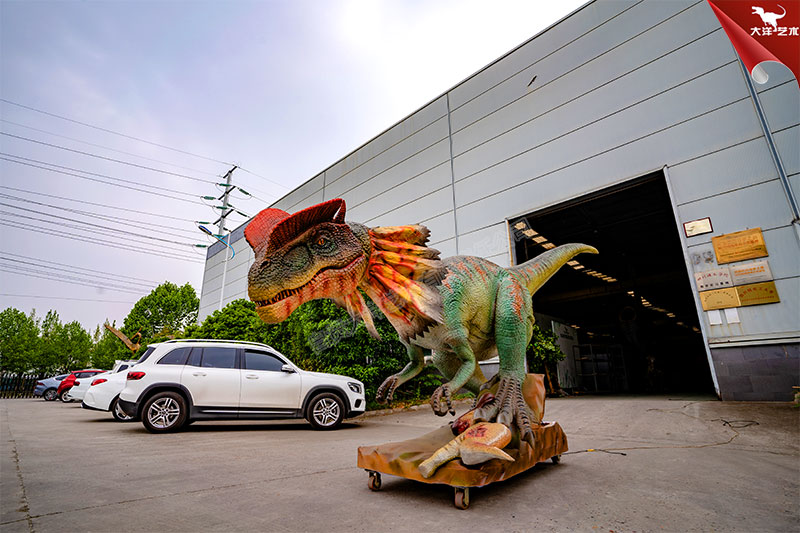
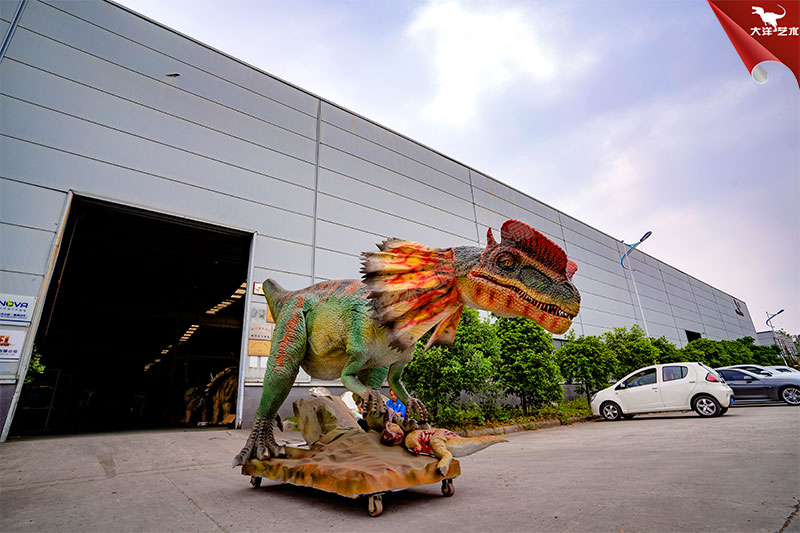
- Price 3500
- Colour: Red, Green
- Dimensions: 6 meters
- Weight: 380kg
- Model number: OAdino-306
- Shipping: Road transport or air freight
- Minimum order: 1 unit minimum order
- Dispatch: Dispatch in 15–40 days after payment
- Business options: Purchase, rental or project cooperation
We travel back in time to the Jurassic period—an era of significant expansion for the dinosaur family. It is estimated that there were between 900 and 1,200 species of dinosaurs during the Jurassic. Today, we will explore a dinosaur that lived during the Early Jurassic and could be considered a king of its time: the Dilophosaurus.
A V-Shaped "Crown" Atop Its Head
The Dilophosaurus—also known for its dual crests—lived during the Early Jurassic. It had a slender build, reaching a length of approximately 6–7 meters and a height of about 2 meters. It derives its name from the pair of thin, brightly colored, crescent-shaped bony crests atop its head. Paleontologists hypothesize that male Dilophosaurus used these striking crests to attract females, with the size and appearance of the crests serving as an indicator of strength. During courtship, a male would display its vibrant dual crests to capture a female's attention and secure a mate.
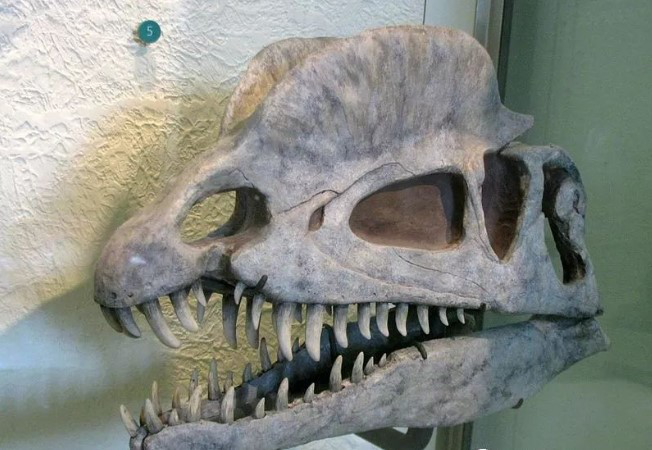
A Rather Slothful Dinosaur
The Dilophosaurus was inherently lazy; it generally did not actively hunt for live prey, preferring instead to subsist as a scavenger. However, when a Dilophosaurus is truly hungry and happens to come across a delicious-looking animal, it will immediately give chase—and may even get into a fierce fight with others to secure the meal.
Dinosaurs with Deadly Weapons
In the world it inhabited, Dilophosaurus sat at the very top of the food chain. As a carnivorous dinosaur, it possessed powerful limbs that allowed it to sprint across flat terrain at remarkable speeds. Its forelimbs were equipped with three razor-sharp claws; any prey unfortunate enough to be caught by them faced a grim fate—being torn to shreds. Its most formidable assets, however, were its sharp teeth—few animals, save for others of its own kind, could ever hope to challenge it. Furthermore, it possessed a secret weapon: when hunting, it could suddenly unleash a spray of lethal venom, rendering its prey unconscious and ensuring that whatever it targeted would inevitably become its next meal. Armed with these "weapons," Dilophosaurus reigned supreme, establishing itself as a dominant predator of the Early Jurassic period.
A Dinosaur Adept at Swimming
Through the study of fossils and trace evidence, scientists have discovered signs that Dilophosaurus was capable of swimming. Paleontologists infer that it was, in fact, a skilled swimmer. When it slipped quietly into the water, it would move slowly—a tactic that led sharks to mistake it for a carcass. Just as a shark would open its jaws to seize this "prey," the Dilophosaurus would suddenly snap its own jaws shut, clamping down on the shark’s midsection. Its rows of razor-sharp teeth would sink deep into the shark’s body, and the predator would then drag its weakened, blood-drained, and helpless victim onto the shore.
A Pioneering Dinosaur That Ruled the Land
In the summer of 1942, a research team led by American paleontologist Charles Camp discovered the first Dilophosaurus fossils within Jurassic-era rock strata in the U.S. state of Arizona. Compared to the colossal dinosaurs of the middle-to-late Jurassic and Cretaceous periods, Dilophosaurus was not particularly large; however, on the Earth of the Early Jurassic, it was undoubtedly the apex predator. The discovery of Dilophosaurus is highly significant—as one of the earliest large carnivorous dinosaurs, it marks the beginning of the era in which dinosaurs dominated the land.
We travel back in time to the Jurassic period—an era of significant expansion for the dinosaur family. It is estimated that there were between 900 and 1,200 species of dinosaurs during the Jurassic. Today, we will explore a dinosaur that lived during the Early Jurassic and could be considered a king of its time: the Dilophosaurus.
A V-Shaped "Crown" Atop Its Head
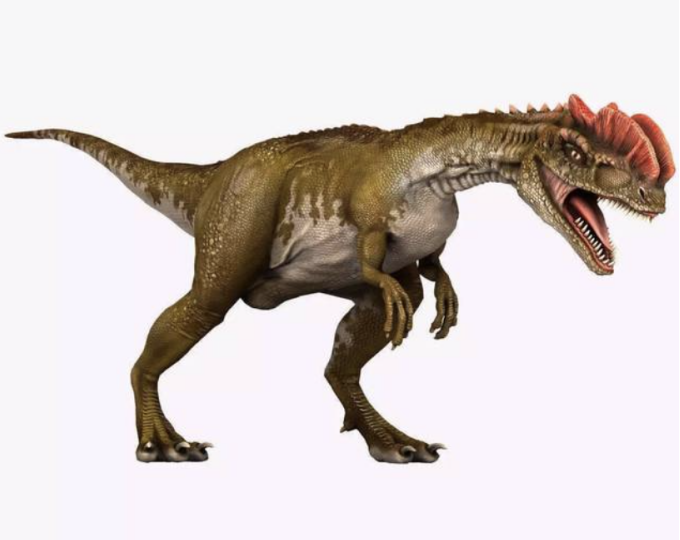
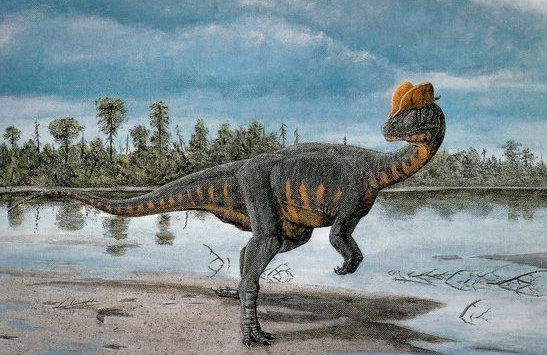
The Dilophosaurus—also known for its dual crests—lived during the Early Jurassic. It had a slender build, reaching a length of approximately 6–7 meters and a height of about 2 meters. It derives its name from the pair of thin, brightly colored, crescent-shaped bony crests atop its head. Paleontologists hypothesize that male Dilophosaurus used these striking crests to attract females, with the size and appearance of the crests serving as an indicator of strength. During courtship, a male would display its vibrant dual crests to capture a female's attention and secure a mate.
A Rather Slothful Dinosaur
The Dilophosaurus was inherently lazy; it generally did not actively hunt for live prey, preferring instead to subsist as a scavenger. However, when a Dilophosaurus is truly hungry and happens to come across a delicious-looking animal, it will immediately give chase—and may even get into a fierce fight with others to secure the meal.
Dinosaurs with Deadly Weapons
In the world it inhabited, Dilophosaurus sat at the very top of the food chain. As a carnivorous dinosaur, it possessed powerful limbs that allowed it to sprint across flat terrain at remarkable speeds. Its forelimbs were equipped with three razor-sharp claws; any prey unfortunate enough to be caught by them faced a grim fate—being torn to shreds. Its most formidable assets, however, were its sharp teeth—few animals, save for others of its own kind, could ever hope to challenge it. Furthermore, it possessed a secret weapon: when hunting, it could suddenly unleash a spray of lethal venom, rendering its prey unconscious and ensuring that whatever it targeted would inevitably become its next meal. Armed with these "weapons," Dilophosaurus reigned supreme, establishing itself as a dominant predator of the Early Jurassic period.
A Dinosaur Adept at Swimming
Through the study of fossils and trace evidence, scientists have discovered signs that Dilophosaurus was capable of swimming. Paleontologists infer that it was, in fact, a skilled swimmer. When it slipped quietly into the water, it would move slowly—a tactic that led sharks to mistake it for a carcass. Just as a shark would open its jaws to seize this "prey," the Dilophosaurus would suddenly snap its own jaws shut, clamping down on the shark’s midsection. Its rows of razor-sharp teeth would sink deep into the shark’s body, and the predator would then drag its weakened, blood-drained, and helpless victim onto the shore.
A Pioneering Dinosaur That Ruled the Land
In the summer of 1942, a research team led by American paleontologist Charles Camp discovered the first Dilophosaurus fossils within Jurassic-era rock strata in the U.S. state of Arizona. Compared to the colossal dinosaurs of the middle-to-late Jurassic and Cretaceous periods, Dilophosaurus was not particularly large; however, on the Earth of the Early Jurassic, it was undoubtedly the apex predator. The discovery of Dilophosaurus is highly significant—as one of the earliest large carnivorous dinosaurs, it marks the beginning of the era in which dinosaurs dominated the land.