
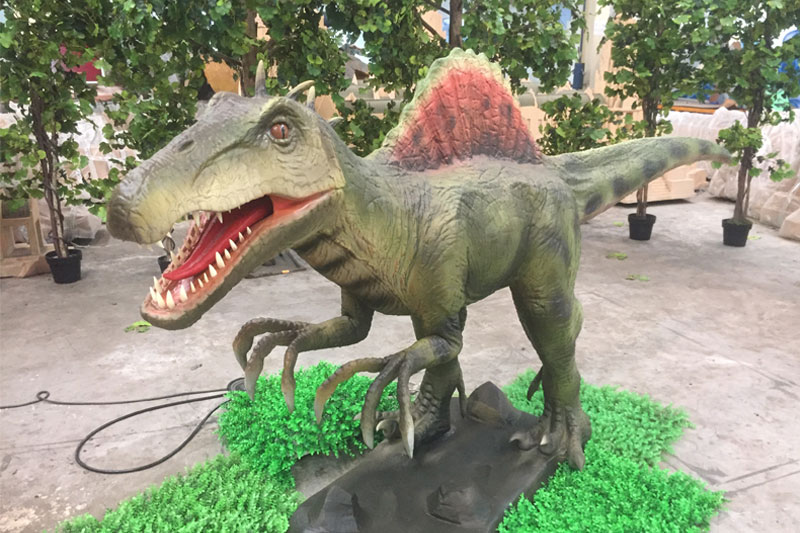
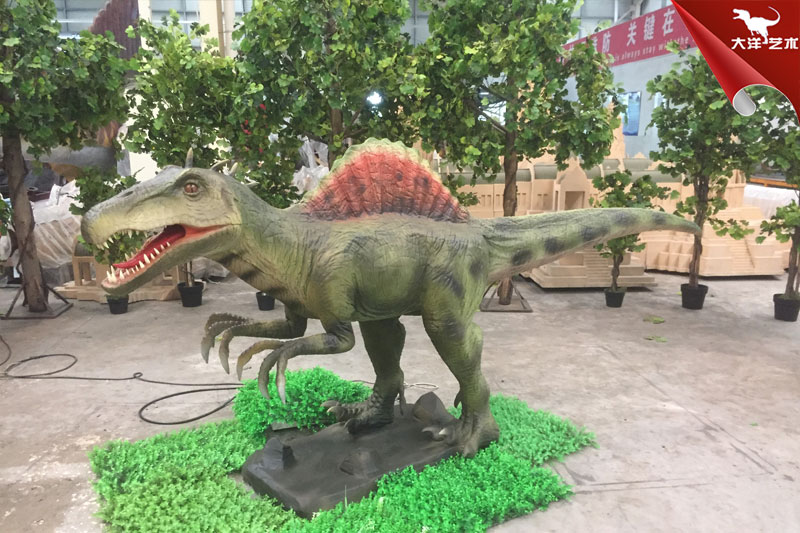
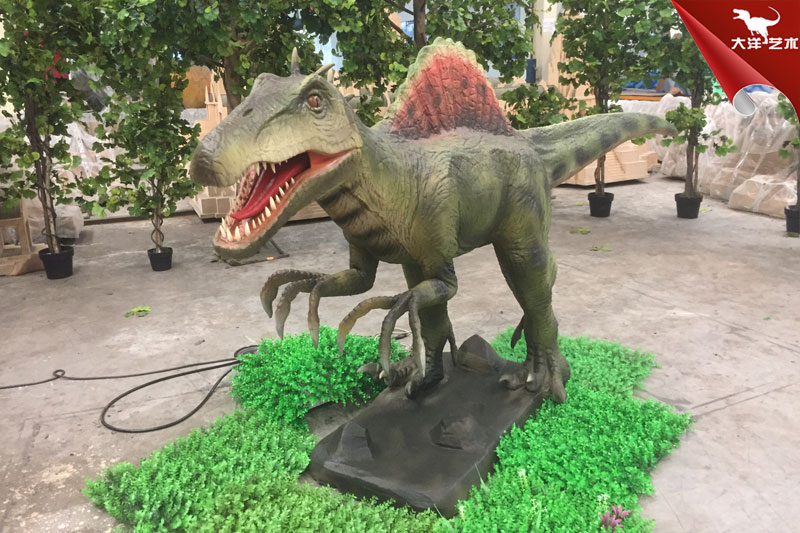
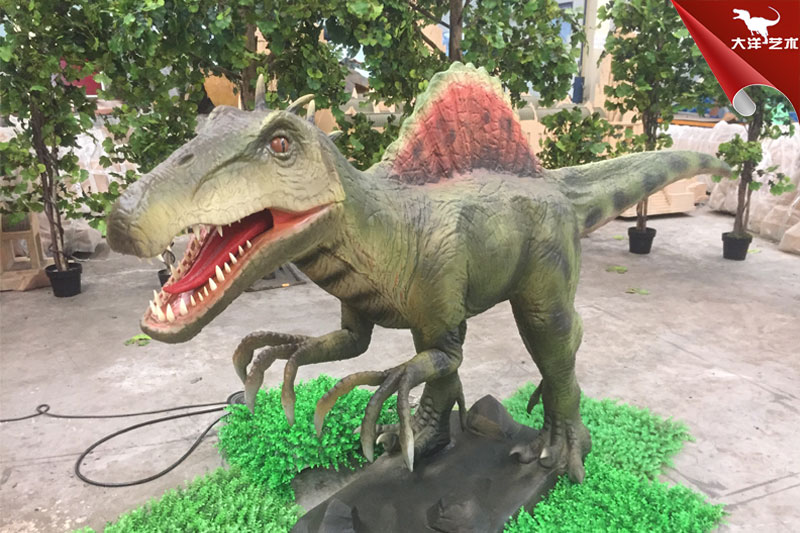
- Price 3200
- Colour: Brown
- Dimensions: 2–10 meters
- Weight: >200kg
- Model number: OAdino-007
- Shipping: Road transport or air freight
- Minimum order: 1 unit minimum order
- Dispatch: Dispatch in 15–40 days after payment
- Business options: Purchase, rental or project cooperation
The name "Spinosaurus" means "spined lizard." It belongs to a group of large, carnivorous theropod dinosaurs. Spinosaurus aegyptiacus—a specific species within this genus—is the largest carnivorous dinosaur known to science as of the 21st century. It reached lengths of 12 to 20 meters, stood 270 to 400 centimeters tall at the hips, and weighed between 4 and 26 tons. It lived in North Africa during the Cretaceous period, roughly 114 to 65 million years ago. Its range included present-day Morocco, Algeria, Libya, Egypt, and Tunisia, with potential occurrences in Western Sahara, Niger, and Kenya. As of the 21st century, two species of the genus Spinosaurus have been identified: the most well-known, S. aegyptiacus, discovered in Egypt, and a second species, S. maroccanus, discovered in Morocco. Spinosaurus was discovered in Egypt by German paleontologist Ernst Stromer, who described it in 1915. The original specimens were destroyed by Allied forces during World War II, making its fossils exceptionally rare and valuable.
Spinosaurus is characterized by prominent, elongated spines on its back, which are extensions of the neural spines of its vertebrae—reaching heights of up to 1.65 meters (based on the largest spine found in the holotype). It is believed that these spines were connected by skin in life, forming a massive, sail-like structure. (However, a very small minority of scientists have proposed that these spines might have been covered by muscle, forming a hump or a ridge, similar to the hump found on the back of an American bison.) The functions of this sail-like structure likely included regulating body temperature, storing fat as energy, dissipating heat, attracting mates, intimidating rivals, and luring prey.
The skull of Spinosaurus measures 1.75 meters in length and resembles that of a pliosaur; the dinosaur is considered to have been semi-aquatic. A study on the oxygen isotope composition of teeth from the Spinosauridae family indicates that Spinosaurus is the only known carnivorous dinosaur capable of swimming.
Spinosaurus is renowned for its distinctive sail and immense size. Much of what is known about the genus comes from relatively complete fossils—which were destroyed during World War II—as well as more recently discovered remains, including teeth, skull fragments, parts of the dorsal sail, arms, claws, and toes. Today, some skull, cervical vertebra, sail, claw, and toe fossils are housed in museums and research institutions; however, fossils of the tail and torso were lost during World War II. Between 2008 and 2013, fragments of the hind limbs and pelvis were discovered in Morocco. A maxilla (upper jaw bone) found in 2005 suggests that Spinosaurus possessed a skull approximately 1.8 meters long. The snout is narrow and lined with straight, conical teeth that lack serrated edges—a characteristic shared with other spinosaurids. The crowns of these teeth can reach up to 12.5 centimeters in length (observed in an uncatalogued, fragmentary specimen from 1915, possibly IPHG-1912-X), with typical tooth lengths ranging from 8 to 15 centimeters.
The sail of Spinosaurus is formed by exceptionally tall neural spines that extend from the vertebrae of the back. These spines are approximately 7 to 11 times the length of the vertebrae themselves. Their length remains relatively consistent along the back, unlike the neural spines of pelycosaurs such as Edaphosaurus or Dimetrodon, which vary significantly in length to create a crescent-shaped sail. Ouranosaurus, an iguanodontian that lived in the same era and region as Spinosaurus, also possessed a tall, sail-like structure on its back, though the tips of its neural spines were thicker.