
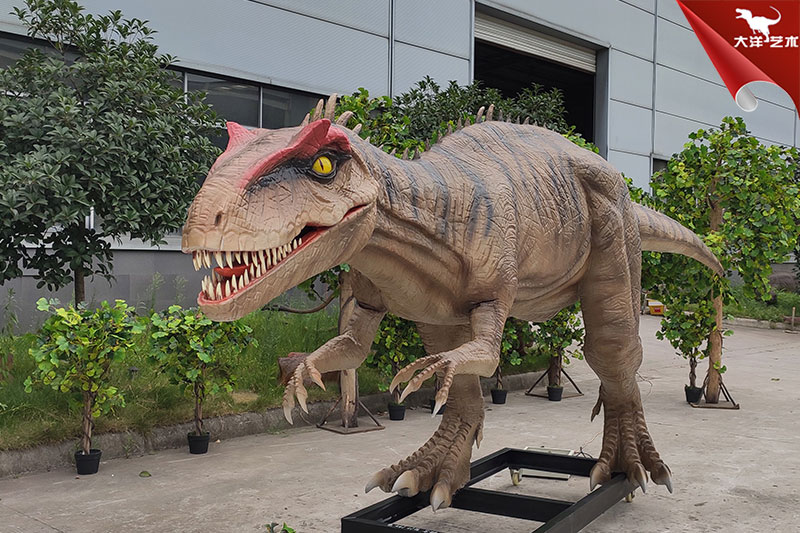
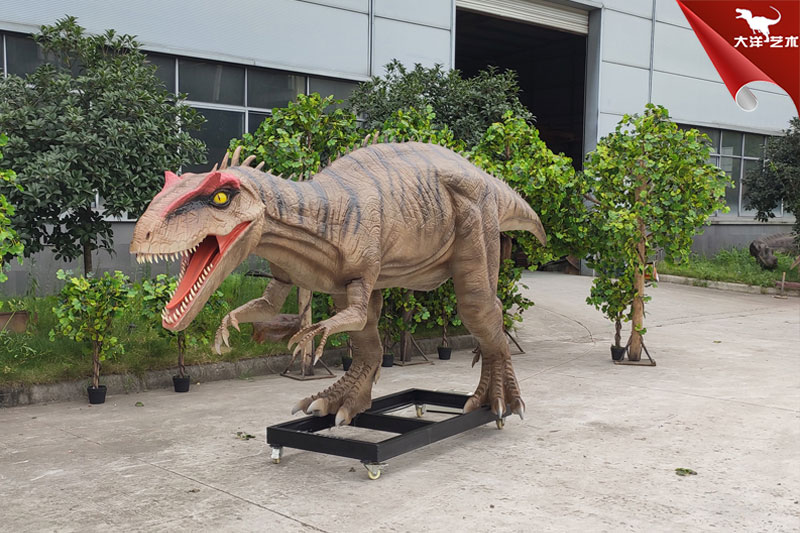
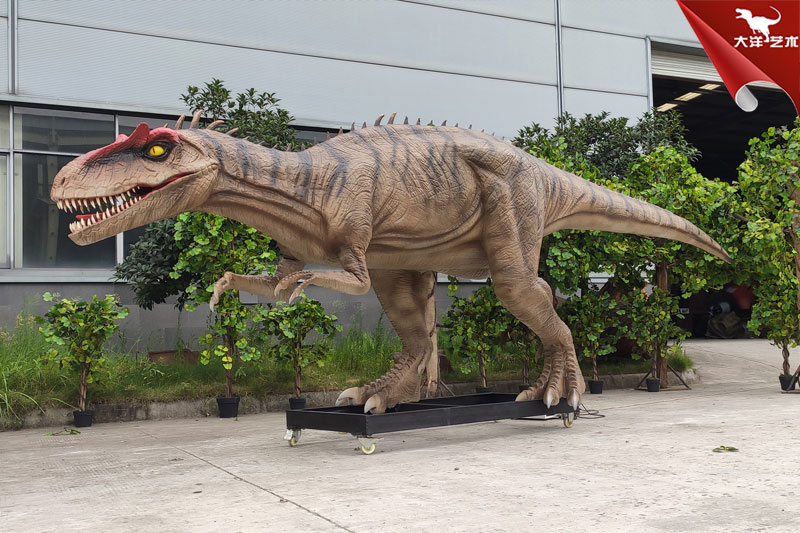
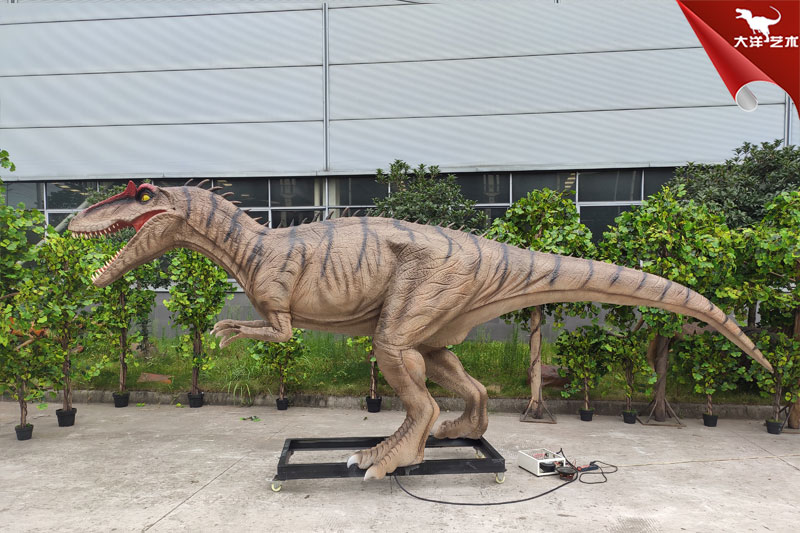
- Price 3200
- Colour: Brown
- Dimensions: 2–10 meters
- Weight: >200kg
- Model number: OAdino-012
- Shipping: Road transport or air freight
- Minimum order: 1 unit minimum order
- Dispatch: Dispatch in 15–40 days after payment
- Business options: Purchase, rental or project cooperation
Torvosaurus—a relative of the well-known Megalosaurus—belongs to the subfamily Megalosaurinae within the superfamily Megalosauroidea (suborder Theropoda). Living during the Late Jurassic period (Kimmeridgian stage, approximately 153 million years ago), Torvosaurus was one of the largest and most formidable carnivorous theropods of the Jurassic, and it holds the title of the largest carnivorous dinosaur discovered in Europe. Its fossil record spans the United States, Portugal, South Africa, Tanzania, and China. It reached lengths of 9–14.2 meters, with a typical weight of 7–8.6 tonnes, and the largest individuals weighing up to 12.2 tonnes. Characterized by a ferocious temperament, it possessed long, powerful legs that allowed for significant speed, a robust and heavily built body, and long teeth designed for both inflicting deep, bleeding wounds and crushing bone. The genus Torvosaurus currently includes five recognized or proposed species: T. tanneri, T. gurneyi, T. foreyi, T. ingens (tentative), and a Chinese representative (referred to as Torvosaurus sp. China). Excluding specimens in private collections, over a dozen cataloged, though incomplete, fossil specimens have been discovered. Due to the fragmentary nature of these fossils, precise dimensions remain difficult to determine; however, one fact is indisputable: it was the largest carnivorous dinosaur of the Jurassic period and of Europe. In the United States, fossil evidence—including remains of an Allosaurus that was killed and consumed by a Torvosaurus—underscores its brutal and aggressive nature, cementing its status as a truly ruthless overlord and a savage, dominant force of the Jurassic era. In 2014, fragmentary skeletal fossils of a Torvosaurus were discovered in China. Subsequent research suggests that these remains represent a new species within the genus Torvosaurus; although it has yet to be formally named, the scientific community currently refers to it as "Chinese Torvosaurus." Because it possesses a physical appearance and build strikingly similar to those of Tyrannosaurus rex—along with a similarly ferocious, predatory temperament and an unassailable status as an apex predator—it has also been dubbed the "Jurassic Tyrannosaurus rex."
Regarded as the premier cold-blooded killer among dinosaurs from the Late Jurassic to the Early Cretaceous, Torvosaurus stands as the largest and most formidable theropod—and the most powerful carnivore—of the Jurassic period; it also ranks as the third-largest theropod overall (based on the size of the largest known individuals). Torvosaurus possessed an elongated skull; paleontologists have reconstructed its complete head by drawing upon data from its close relatives, with the largest estimated skull reaching 1.52 meters in length. Its massive size did not hinder its speed; equipped with long, exceptionally robust leg bones, it was even faster than Allosaurus, allowing it to swiftly overtake and bring down its prey. Prior to 2011, the genus Torvosaurus comprised two species: T. tanneri (found in the United States and Portugal) and T. rex (found in the United States). Torvosaurus possessed an immense bite force, reaching up to 15 tons. Its claws, which could grow as long as 42 centimeters, served as lethal hunting weapons. In 2012, large teeth belonging to the genus Torvosaurus were discovered in Tanzania and South Africa, leading to the establishment of two new species: T. ingens and T. africana. With its sturdy skeletal structure, long teeth designed for both inflicting deep, bleeding wounds and crushing bone, high agility and running speed, a powerful, robust build, well-developed forelimbs with large claws, and a formidable bite force, Torvosaurus is the largest and most formidable carnivorous dinosaur discovered from the Jurassic period to date. However, its immense body size meant that it was relatively slow when making turns. In 2014, the Portuguese population was classified as a distinct species, Torvosaurus gurneyi. Also in 2014, fragmentary skeletal fossils of a Torvosaurus were discovered in China. Research suggests these belong to a new species within the genus Torvosaurus; while it has yet to be formally named, the scientific community currently refers to it as "Chinese Torvosaurus."